
BJERKE / DSGN
Senior Design Lead · IBM
Challenge
The Problem
What we were solving
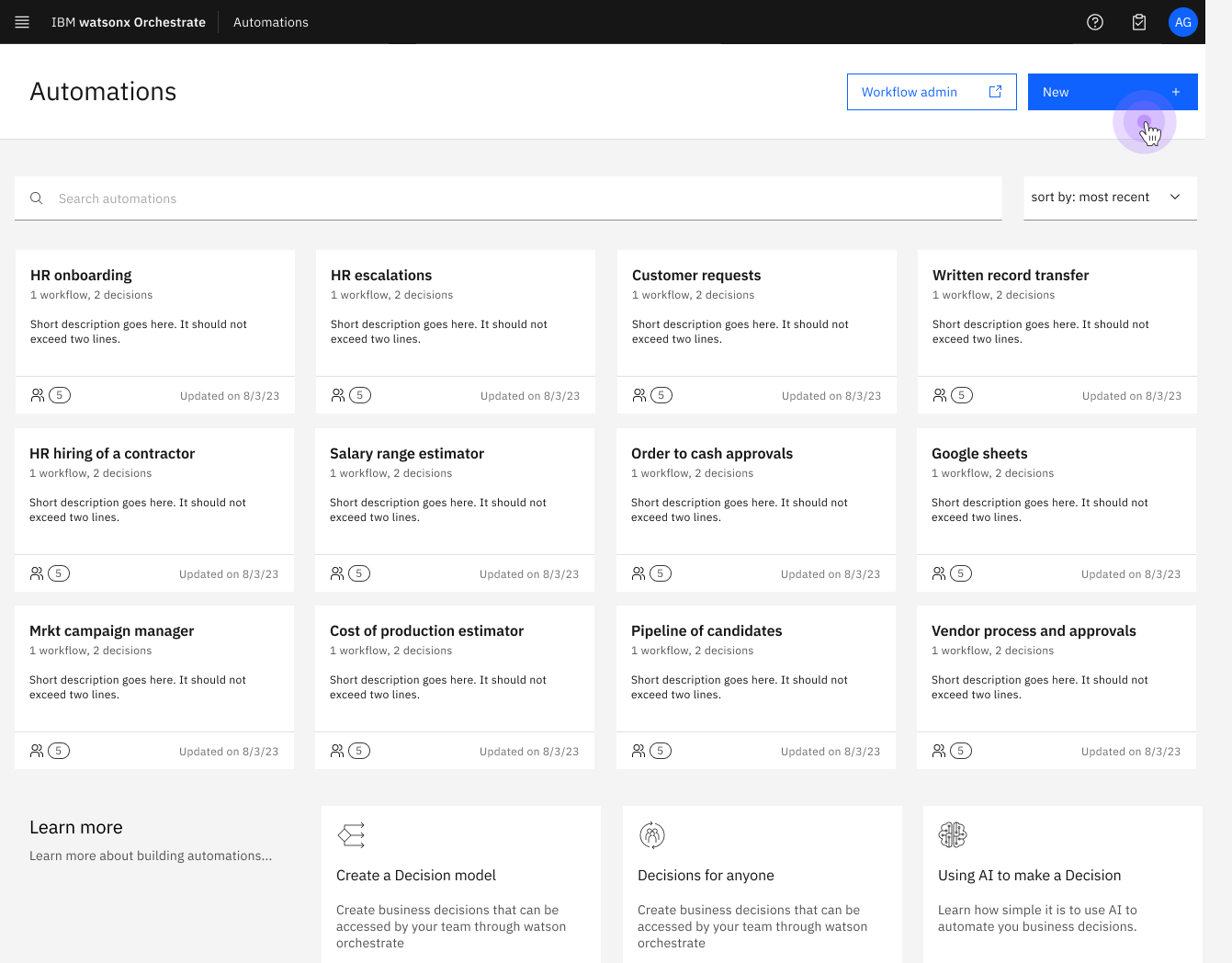
IBM had three separate automation products — IBM Business Automation Workflow, the old watsonx Orchestrate Skill Builder / Conversational Actions, and Automated Decision Service — each with its own UX patterns, mental models, and interaction paradigms. Users moving between them hit constant friction. They needed to live together inside watsonx Orchestrate as a unified experience.
Design goal
Consolidate three distinct automation products into one coherent experience within watsonx Orchestrate, without wholesale redesigning each individual product — instead focusing on the connecting tissue that makes them work together.
Constraints
- ·
Could not fully redesign each individual product — too much existing user investment
- ·
Three teams with different technical constraints and roadmap timelines
- ·
Must maintain backward compatibility for existing users of each product
- ·
8-designer team across multiple geographies requiring strong design coordination
How we learned
Research
Findings
Research showed that users weren't moving fluidly between the three products — they were siloed by the tool they'd learned first. The primary insight was that the mental model problem was as significant as the UI problem: users needed a unified way to think about automation, not just a unified interface. The design focused on establishing shared vocabulary and entry points before addressing individual product UX.
Methods
- 1.
Cross-product workflow mapping
- 2.
User interviews across all three product user bases
- 3.
Stakeholder alignment sessions with three separate product teams
- 4.
Competitive analysis of automation platform consolidations
Users who learned one automation product first rarely explored the others — not because they didn't need them, but because the entry points and terminology didn't connect. The consolidation needed to solve the discovery problem before the usability problem.
— User Interviews
Three separate canvas-based building experiences created a pattern proliferation problem. This became the seed of a longer-term design strategy revisited during Agent Builder.
— Design Retrospective
How we worked
Process
Cross-Product Discovery · 3 weeks
Mapped the UX patterns, mental models, and user workflows across all three products to identify where friction occurred at the seams.
Unified IA & Entry Points · 5 weeks
Designed a shared information architecture and entry point system that let users navigate between products without losing context — the connecting tissue strategy.
Team Coordination & Delivery · 8 weeks
Coordinated design work across an 8-person team in multiple geographies, scoping and prioritizing work items while managing three separate product team stakeholders.
Launch & Iteration · Ongoing
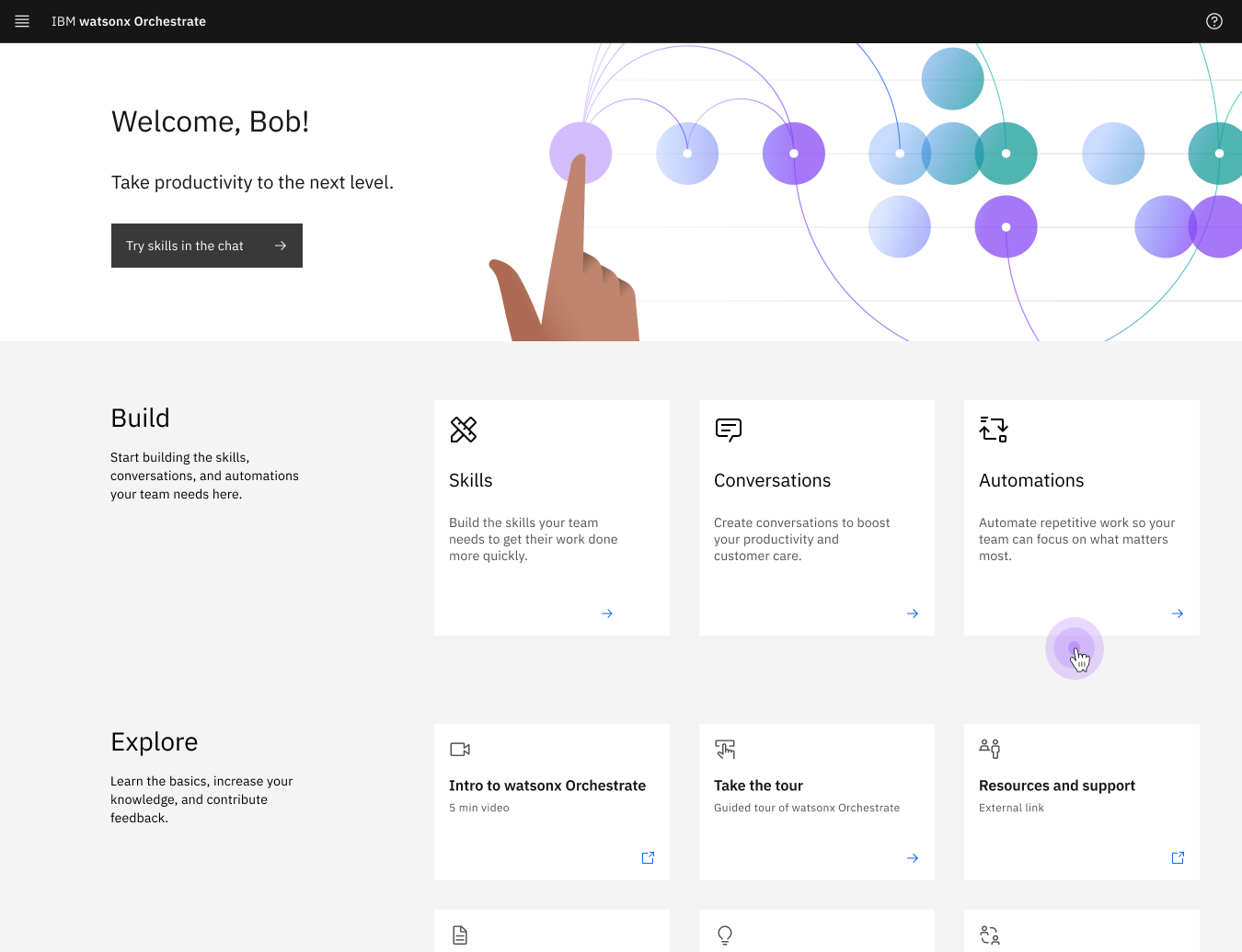
Shipped the unified experience inside watsonx Orchestrate. Observed early adoption patterns to inform the Agent Builder strategy that would follow.
watsonx Orchestrate — Nov 2023 Release
Impact
Outcomes
Summary
The Unified Automation Builder shipped inside watsonx Orchestrate, consolidating three separate products into one coherent experience. The HR promotion workflow automation alone saved 12,000 hours per year, and consistent, traceable execution reduced compliance risks across enterprise customers.
HR workflow automation — annual time savings
Manual error rate
You and I have had a great blend of tactical, UI-focused discussions regarding our users, their needs, and the various implementation challenges we've seen, as well as broad and strategic conversations as to where to take some of the solutions you have influenced and lead.
Design Manager, watsonx Orchestrate